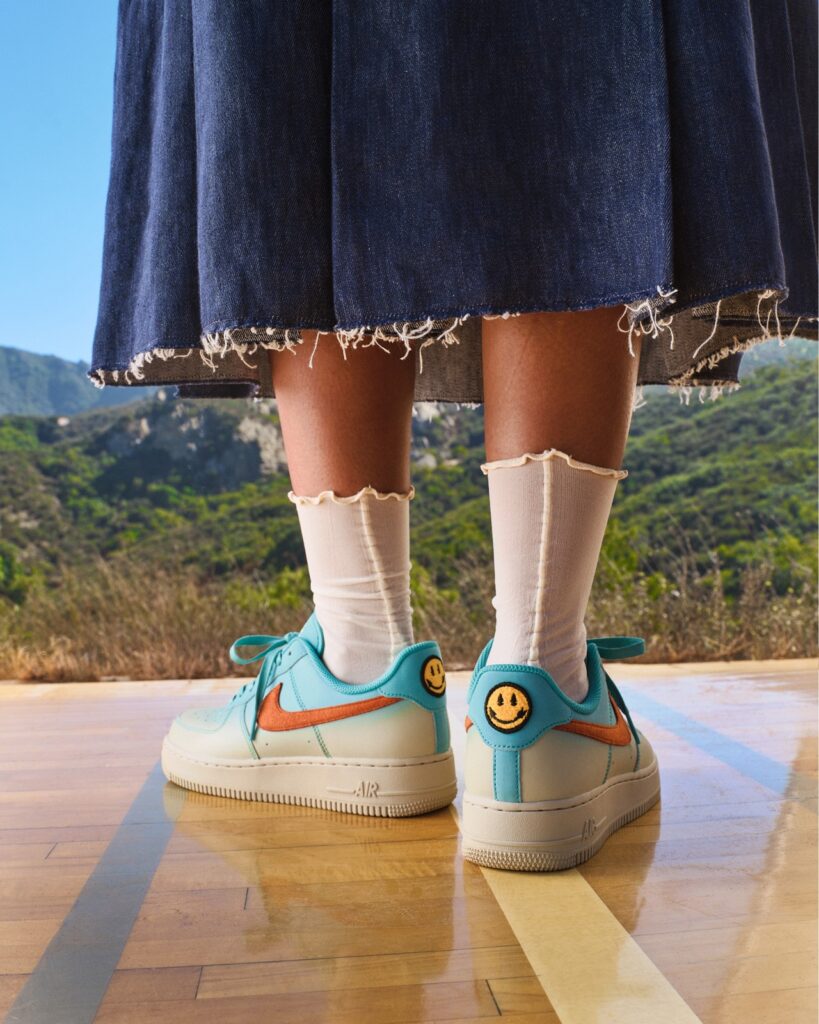
Nike releases the Air Force 1 ’07 LV8 N7 globally on November 7, alongside the G.T. Cut 4 N7 and a run of apparel, all of it designed with Kiowa and Choctaw artist Steven Paul Judd. The Cut 4 is the harder argument, a performance basketball shoe carrying Indigenous design onto a court. The Air Force 1 is the easier one, and that is exactly why it is the more consequential of the two.
Nike’s N7 program traces back to Sam McCracken, who pitched it to company executives in 2000 and has run it since. The name comes from a Native principle of seven generations, the idea that a decision is measured against the people who came before and the people who will inherit it. The N7 Fund has distributed money to organizations serving Indigenous communities across North America since 2009, and Nike’s own figures with this release put that at $15.2 million to 324 organizations, with $625,000 going out annually since 2022 through CAF America. The product has always been the fundraising mechanism and the visibility at once. As for the shoe carrying it, the Air Force 1 ’07 LV8 is Nike Sportswear’s upgrade tier on a 1982 Bruce Kilgore basketball shoe that nearly lapsed before a handful of retailers kept it alive. LV8 means elevated, and in practice it is the version Nike uses when a pair needs materials or graphics the standard build will not hold. It is also the single highest-volume sneaker the company makes, which matters more here than it usually does.
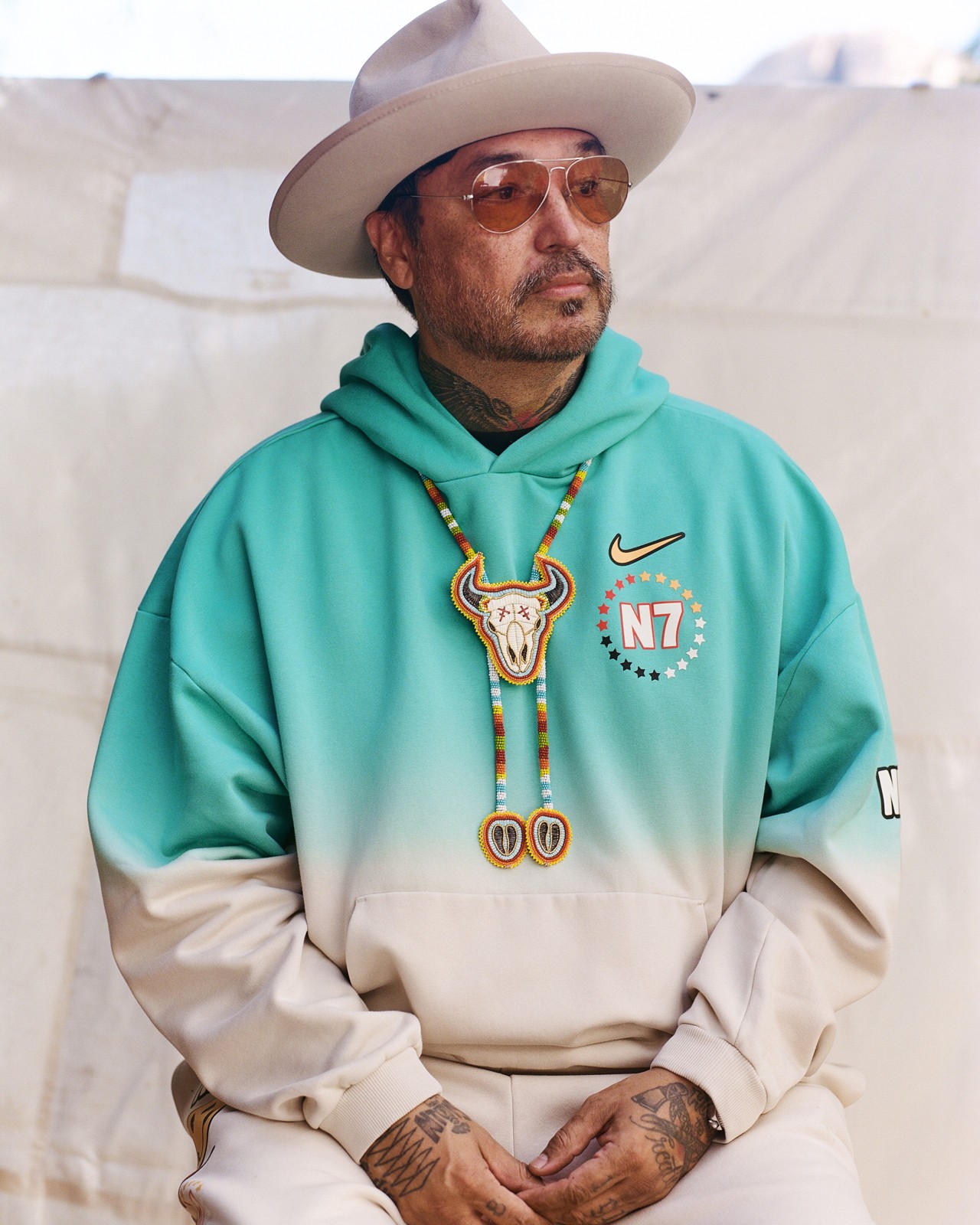
Judd’s work on this pair comes out of hand-dyed garments and what Nike describes as the gradients of Oklahoma sunsets. The palette moves across warm neutrals, sunbaked golds, reds and horizon blues, with material nods to handmade footwear including suede and chenille. The detail doing the most work is the smiley face, redrawn so the features become arrow and arrowhead forms. Judd is explicit about why it is there. “Sometimes people think Native art is always supposed to be serious and historical,” he says. “One of the things I love most about Native communities is our sense of humor. We laugh a lot, we tease each other.” The campaign imagery puts the pair on foot outdoors rather than on a studio table, which is the correct read of where this shoe lives. Nike has not published a materials breakdown beyond those references, so the exact construction stays unconfirmed until the pair is on a shelf.
A signature basketball shoe reaches the people who already follow basketball. An Air Force 1 reaches everyone else, and it does it for years, because the silhouette does not go out of rotation the way a performance model does. If the point of N7 is that Native youth see themselves reflected, then the shoe that sits in general release at the front of a wall does more of that job than the one that sells out to guards. Nike has run collaborator graphics on the Air Force 1 for two decades, from Nigo’s recent pair to regional makeups like What The LA. The difference here is that the graphics are load bearing rather than decorative. Judd was not handed a template to fill. He says every detail holds a deeper purpose, and the smiley, the one element a passerby will register from across a room, is the one he built the argument around. That is a harder brief than a colorway, and it is the kind of work that only pays off on a shoe people keep wearing after the release week is over.
Nike has published no retail figure and no style code for either N7 shoe, which is unusual this close to a dated global release and means the number is unconfirmed until the pair appears on Nike.com. For orientation, recent Air Force 1 ’07 LV8 releases on this site have landed at $125 for What The LA and $140 for the Air Force 1 ’01. An LV8 with this much material work on it would sit at the upper end of that band if it follows the pattern, though nothing in Nike’s announcement commits to it.
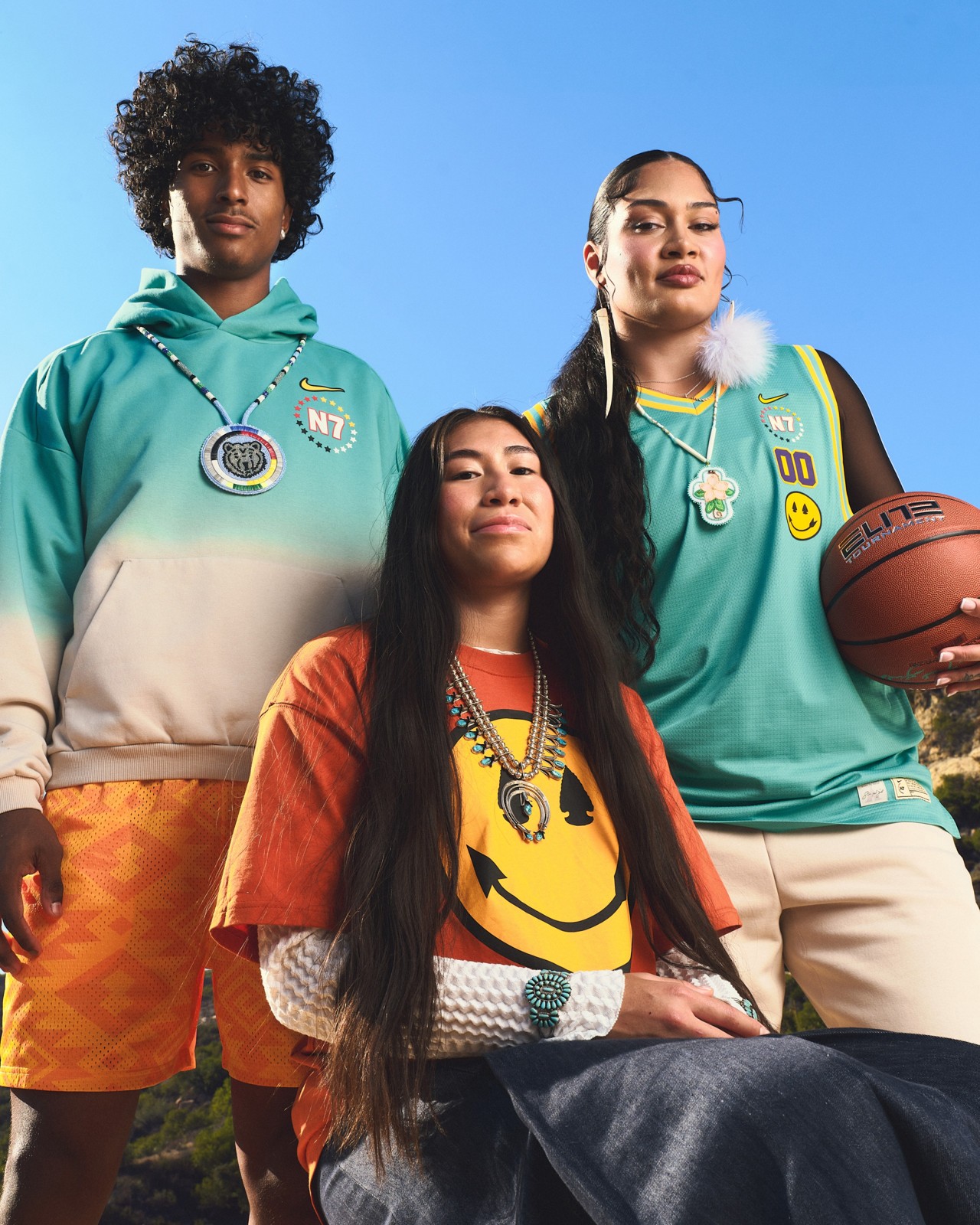
The Nike Air Force 1 ’07 LV8 N7 releases globally on November 7 at Nike.com and select retail locations, with the G.T. Cut 4 N7 and the N7 apparel. The timing lines up with Native American Heritage Month and with the opening of applications for the N7 Fund. Nike has not released a style code or a price. Three Native athletes front the campaign: Alissa Pili, who is Inupiaq and Samoan, Sydney Benally, who is Navajo, and Keonte Greybear, of the Standing Rock Sioux Nation.
-->